Do SPY and QQQ Move Together?
Scope: measured on the ETFs listed (SPY, QQQ, IWM, DIA, GLD, SLV). Findings apply to the instruments measured and do not automatically transfer to other markets.
89.3% of regular-session hours, SPY and QQQ close the hour in the same direction — and the agreement is not evenly spread. Sort the hours by how far SPY moved and the story sharpens: in SPY's quietest quarter of hours the two agree only 67.8% of the time, in the middle half 94.7%, and in SPY's biggest quarter of hours 99.8%. Disagreement between the two index families lives almost entirely in the noise-sized hours. When one of them is genuinely moving, the other is moving with it. For anyone holding both funds, or choosing between them, the practical question is whether they diversify each other at all; in any hour that matters, they do not.
Window: 2025-02-10 to 2026-08-14, 380 regular sessions, one-minute bars aggregated to complete hours (10:00–15:59 ET). Direction = last print of the hour vs last print of the prior hour; hours where either fund closed flat are excluded. n = 2,269 hour-pairs for SPY–QQQ.
How often do the major index ETFs agree on direction?#
Often — and how often depends on which pair, which is what makes the number meaningful rather than a truism. Same measurement, five pairs:
| Pair | Hourly agreement | Session agreement |
|---|---|---|
| SPY – QQQ | 89.3% | 88.9% |
| SPY – DIA | 83.8% | 81.5% |
| SPY – IWM | 78.2% | 76.8% |
| GLD – SLV | 79.2% | 75.8% |
| SPY – GLD | 60.3% | 59.3% |
Same window and method throughout; session direction = final regular-hours print vs the 09:30 first print, n = 376–380 sessions per pair. Hourly n = 2,247–2,269 per pair.
The ordering is the finding. The two large-cap index funds agree the most; the small-cap fund agrees with them noticeably less; the two metals agree with each other about as much as IWM agrees with SPY; and equity–gold agreement, at 60.3%, sits closest to a coin flip — the pairs are ranked by how much underlying they actually share. Co-movement here is not "everything moves together"; it is a measurable quantity that differs by pair in a stable, explainable order.
When do SPY and QQQ disagree?#
Almost exclusively when nothing much is happening. Conditioning the SPY–QQQ hourly agreement on the size of SPY's own move:
| SPY's hourly move | Agreement | n |
|---|---|---|
| Smallest quartile (under 0.054%) | 67.8% | 565 |
| Middle half (0.054%–0.260%) | 94.7% | 1,136 |
| Largest quartile (over 0.260%) | 99.8% | 568 |
Quartile cuts computed on SPY's absolute hourly move over the same window.
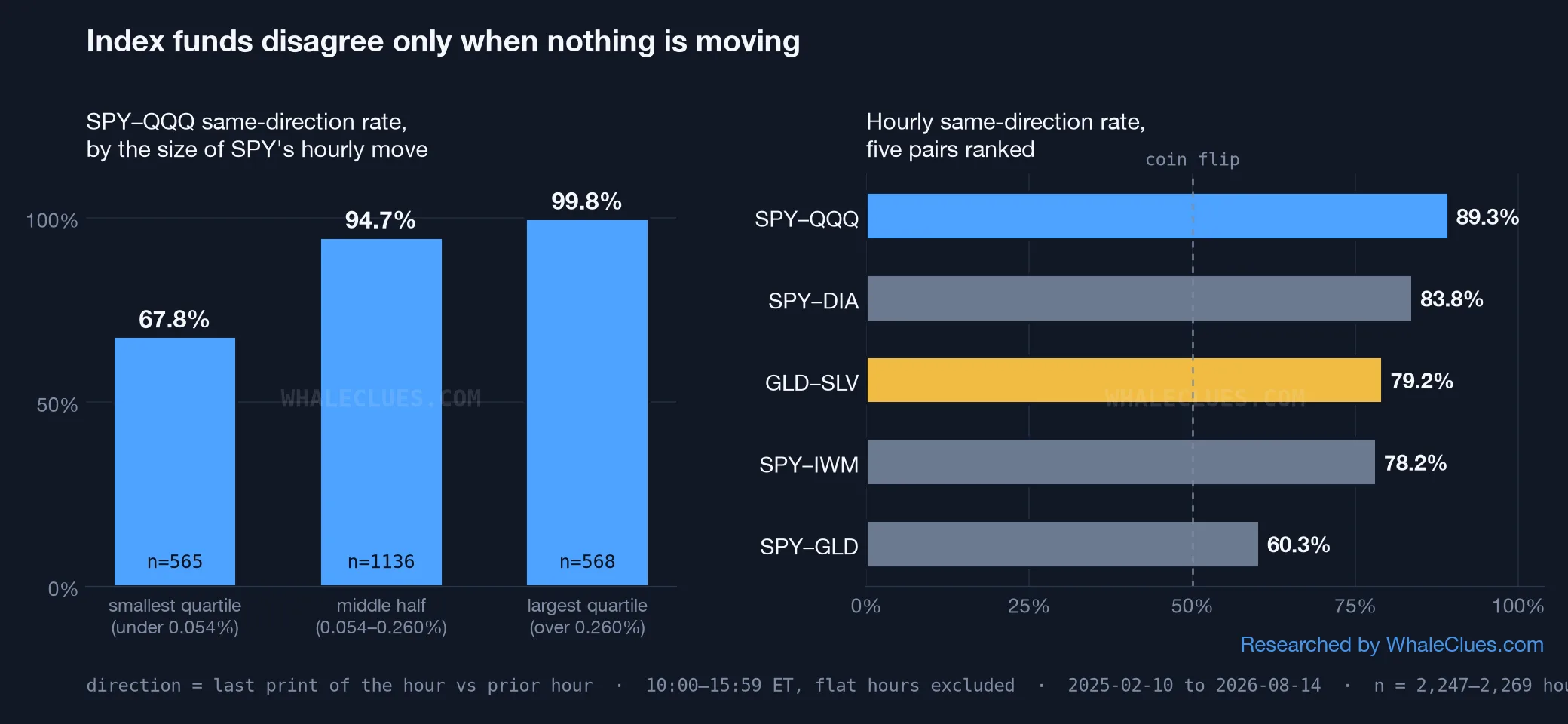
In the largest-move quartile, disagreement essentially does not happen: one discordant hour in five hundred sixty-eight. A number that high deserves suspicion, so we audited it rather than admired it. The single discordant hour is 25 June 2026, 12:00 — SPY −0.270% (barely above the quartile cut) against QQQ +0.025% (a near-flat drift): exactly the boundary case one would expect, not a hidden data problem. The tie-exclusion rule inflated nothing — across all 2,274 joint hours only two QQQ-flat hours exist, and zero fell in the top bucket. And harsher versions of the question only push the number up: in the top decile of SPY moves (over 0.443%), agreement is 100% of 227 hours, and re-measuring with intra-hour direction (first print vs last print of the same hour) also gives 100% in the top quartile.
The mechanism is not mysterious — both funds are dominated by the same macro factor, and when that factor is loud it swamps whatever is idiosyncratic to one basket; when it is quiet, the residual differences (sector weights, single-name moves) are all that is left to set the sign of a small drift. The disagreement sources amount to a few basis points of relative drift, and a few basis points cannot flip the sign of a quarter-percent hour. But the size of the asymmetry is worth having as a number rather than a feeling: direction disagreement between SPY and QQQ is a property of quiet hours, not of active ones.
Do GLD and SLV move together?#
Yes, but less tightly than the two large-cap index funds: GLD and SLV closed the same hour in the same direction 79.2% of the time, and the same session 75.8% — about the level at which IWM agrees with SPY, and well above the 60.3% at which gold agrees with the equity index. Same window and method as the pairs table above; n = 2,247–2,269 hour-pairs.
Two readings follow for anyone holding both metals. Diversification between them is limited: in roughly four hours out of five they move together, so a GLD position and an SLV position are mostly one exposure with two tickers. And the gap between 79.2% and SPY–QQQ's 89.3% is a real difference in how much underlying the pair shares — the usual explanation is silver's industrial demand, which gold lacks, and this note did not test that explanation. Whether the metals' agreement climbs with move size the way SPY–QQQ's does was not measured here either: the conditional table above is SPY–QQQ only.
Is QQQM the same as QQQ? And how far do VOO and VGT sit from it?#
QQQM and QQQ are the same portfolio in two wrappers, and daily prices say so: over the year to 28 August 2026 their daily returns had a correlation of 0.9998, closed in the same direction on 99.6% of days, and finished the year 0.02 percentage points apart in price return (+24.15% against +24.17%). The gaps that do matter are structural, not statistical: QQQ charges more, trades far more shares, and is the one with a liquid options market, which matters only if you trade options; QQQM is the cheaper wrapper for a buy-and-hold position. VOO is the S&P 500 in the same way SPY is, and VGT is a different animal that happens to rhyme.
| Pair | Daily-return correlation | Same-direction days | One-year price return |
|---|---|---|---|
| QQQ – QQQM | 0.9998 | 99.6% | +24.15% vs +24.17% |
| SPY – VOO | 0.9979 | 98.8% | +18.56% vs +18.56% |
| QQQ – VGT | 0.9533 | 94.4% | +24.15% vs +35.70% |
| QQQ – VOO | 0.9291 | 88.4% | +24.15% vs +18.56% |
Daily closing prices, 2025-08-28 to 2026-08-28, 251 daily returns per pair (250 where a holiday close differs). Price return only, dividends excluded, so the QQQ–QQQM gap here is the price gap, not the total-return gap; the expense-ratio difference shows up in total return over years, not in daily co-movement. Same-direction days exclude days where either fund closed flat. Over the two years to the same date the picture is identical: QQQ–QQQM 0.9998 and 99.6%, SPY–VOO 0.9968 and 98.8%, QQQ–VGT 0.9677 and 92.6%.
Two readings follow. First, "QQQ vs QQQM" is not a co-movement question at all; the two funds cannot diverge in any way this measurement can see, so the choice is about cost, share price and whether you need the options chain. Second, VGT is not a Nasdaq-100 substitute: it agreed with QQQ on direction on 94.4% of days, the weakest pair in this table, and the one-year return gap was over eleven points, because VGT is a single-sector fund and the Nasdaq-100 is not. The hourly ladder above is about what the market does; this table is about what you actually own.
What does this license a reader to do?#
Read the two families as one macro tape when the tape is loud — with stated limits.
- Confirmation has a base rate now. "QQQ is moving but SPY isn't confirming" means something different in a 0.03% hour (where disagreement is routine) than in a 0.4% hour (where it happened twice per thousand). The size of the move, not the disagreement itself, decides whether divergence is information.
- This is simultaneity, not sequence. Both funds' hours are measured over the same clock. Nothing here says which one moved first inside the hour, so nothing here supports "SPY moved, therefore QQQ will follow" as a timing trade — that is a lead-lag question this measurement cannot see. The structural reasons the families track each other are in one market, many tapes.
- The pair matters. Extending index logic to metals fails immediately: SPY–GLD at 60.3% is barely better than chance. Co-movement earns its use pair by pair, and the table above is the check.
Limits worth stating#
- Direction only. Agreement counts sign, not size: an hour where SPY rose 0.30% and QQQ rose 0.02% counts as agreement. Magnitude co-movement is a different measurement.
- Hours are one resolution. Minute-level or day-level agreement will differ; the session column above suggests the day-level picture is close to the hourly one, but finer resolutions were not measured here.
- One window, one regime mix. 380 sessions spanning 18 months, whatever mixture of trend and chop that contained. The conditional pattern (agreement rising with move size) is the part most likely to survive regime changes; the exact percentages are the part least likely.
- ETFs, not futures. Measured on SPY and QQQ bars. The futures contracts on the same indexes are held to them by arbitrage, so the co-movement logic transfers structurally — but the numbers above were not measured on futures and are not claimed for them.
Related reading#
- One market, many tapes — why evidence in one wrapper is evidence about all of them, and where that logic stops.
- SPX, SPY, ES — three prices for one index — the wrappers of each family and what separates their levels.
- The overnight gap is mostly over before you see it — the same instruments, measured where the sessions do not overlap.
See these levels on a live chart
Whale-sized prints, XJER and key levels on one order-flow chart.